Home » PAYING YOUR TAX (Page 13)
Category Archives: PAYING YOUR TAX
When To File An Amended Tax Return

However, you should file an amended return if any of the following were reported incorrectly:
Your filing status
Your dependents
Your total income
Your deductions or credits
If the changes involve other schedules or forms, attach them to the Form 1040X. For example, if you are filing a 1040X because you have a qualifying child and now want to claim the Earned Income Credit, you must attach a Schedule EIC to show the qualifying person’s name, year of birth and Social Security number.
Form 1040X, Amended U.S. Individual Income Tax Return
Has Your Mortgage Debt Been Forgiven? Here Are Some Things You Should Know

There is tax relief for struggling homeowners. If your mortgage debt is partly or entirely forgiven at any time during 2007 through 2012, you may be able to claim special tax relief on your federal income tax return for that year.
Here are six things the IRS wants you to know about mortgage debt forgiveness.
1. Normally, debt forgiveness results in taxable income. However, under the Mortgage Forgiveness Debt Relief Act of 2007, you may be able to exclude from tax up to $2 million of debt forgiven on your principal residence. The limit is $1 million for a married person filing a separate return.
2. Debt reduced through mortgage restructuring, as well as mortgage debt forgiven in connection with a foreclosure, may qualify for this relief.
3. The debt must have been used to buy, build or substantially improve your principal residence and must have been secured by that residence. Debt used to refinance qualifying debt is also eligible for the exclusion, but only up to the amount of the old mortgage principal, just before the refinancing.
4. Debt forgiven on second homes, rental property, business property, credit cards or car loans does not qualify for the tax-relief provision. In some cases, other kinds of tax relief – based on insolvency, for example – may be available.
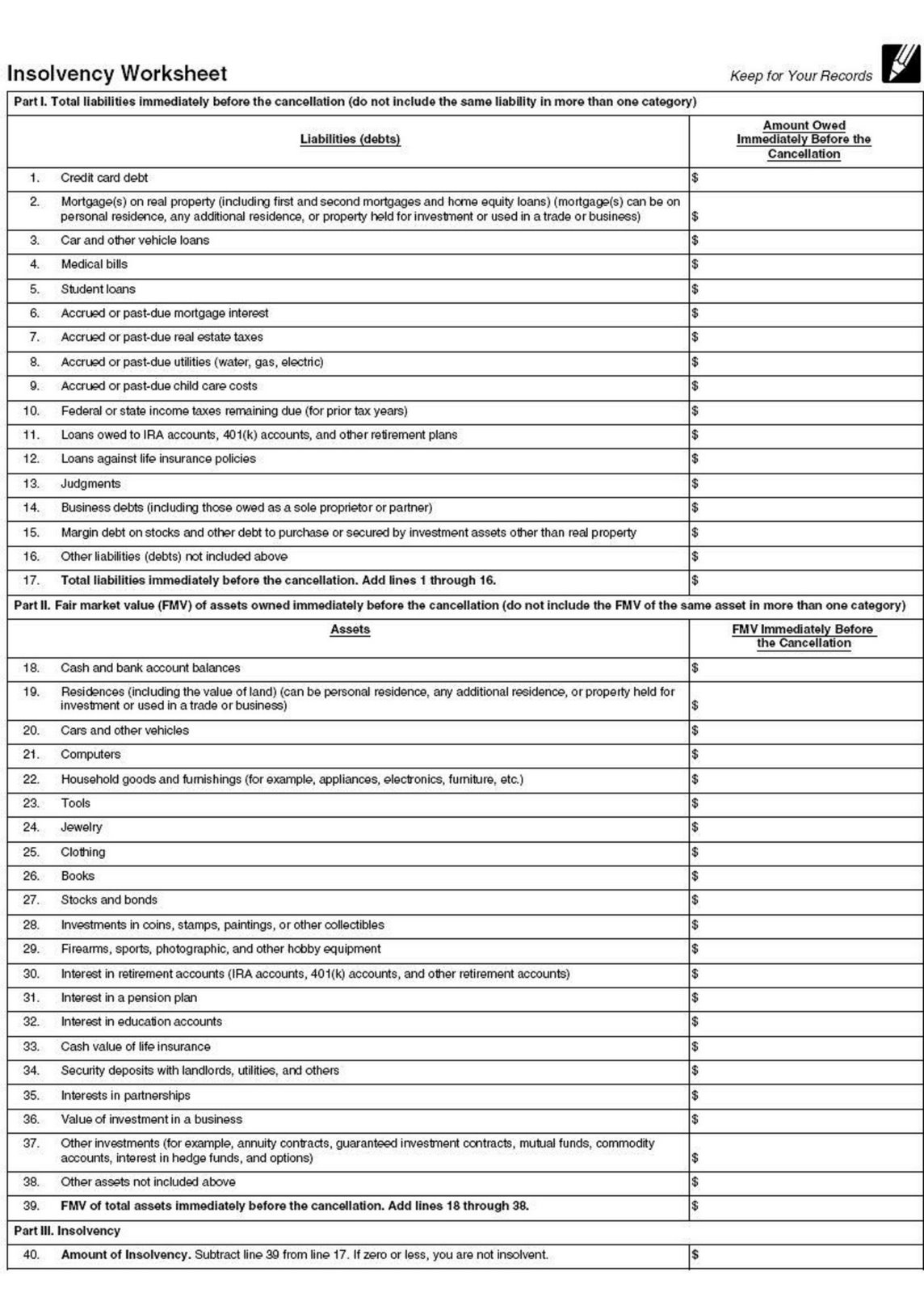
5. If your debt is reduced or eliminated you should receive a Form 1099-C, Cancellation of Debt, from your lender. By law, this form must show the amount of debt forgiven and the fair market value of any property given up through foreclosure.
6. Taxpayers who qualify claim the special exclusion by filling out Form 982, Reduction of Tax Attributes Due to Discharge of Indebtedness, and attaching it to their federal income tax return for the year.
For more information about the Mortgage Forgiveness Debt Relief Act of 2007, visit the IRS Web site at IRS.gov. A good resource is IRS Publication 4681, Canceled Debts, Foreclosures, Repossessions and Abandonments. This publication and Form 982 can be downloaded from IRS.gov or ordered by calling 800-TAX-FORM (800-829-3676).
Links:
IRS Publication 4681, Canceled Debts, Foreclosures, Repossessions and Abandonments (PDF)
Form 982, Reduction of Tax Attributes Due to Discharge of Indebtedness (PDF)
 Stacie's Tax Stuff